

2026-07-20 Return list
Common Complications of Hyaluronic Acid Fillers and How Experienced Injectors Prevent Them
Hyaluronic acid (HA) fillers have become one of the most popular non-surgical aesthetic treatments worldwide. Thanks to their excellent biocompatibility, reversibility, and natural-looking results, they are widely used for facial rejuvenation, contouring, and volume restoration.
Like any injectable treatment, however, HA fillers are not entirely risk-free. Most complications are uncommon and can often be minimized through proper patient assessment, sound anatomical knowledge, appropriate product selection, and skilled injection techniques.
In this article, we'll explore the most common hyaluronic acid filler complications and explain how experienced injectors help reduce these risks to achieve safer, more predictable outcomes.
Are Hyaluronic Acid Fillers Safe?
When performed by qualified medical professionals using high-quality products, hyaluronic acid fillers have an excellent safety profile. Unlike many other injectable materials, HA is naturally present in the human body and can be dissolved with hyaluronidase if necessary, providing an additional layer of safety.
While mild reactions such as temporary swelling or bruising are relatively common, serious complications are rare. The majority of adverse events are associated with improper injection techniques, inadequate anatomical knowledge, or selecting an unsuitable filler for the treatment area rather than the filler material itself.
Common HA Filler Complications
Swelling and Bruising
Temporary swelling and bruising are the most frequently reported side effects after HA filler injections. They usually result from minor trauma to blood vessels during treatment and typically resolve within several days.
Experienced injectors reduce these reactions by using gentle injection techniques, minimizing tissue trauma, and providing patients with appropriate aftercare instructions.
Tyndall Effect
The Tyndall effect appears as a bluish discoloration beneath the skin when filler is placed too superficially. It most commonly occurs in delicate areas with thin skin, such as the tear trough.
Proper injection depth, careful product selection, and a thorough understanding of facial anatomy are key to preventing this complication.
Filler Migration
Filler migration occurs when the injected gel moves away from the intended treatment area, leading to uneven contours or an unnatural appearance. This may result from overcorrection, incorrect product selection, or placement in an inappropriate tissue layer.
Choosing the right filler for each indication and using conservative injection volumes help maintain stable and natural-looking results.
Nodules and Irregularities
Small lumps or irregularities may occasionally develop if filler is unevenly distributed or injected into the wrong tissue plane. In many cases, these can be minimized through precise injection techniques and careful product placement.
Vascular Occlusion
Although uncommon, vascular occlusion is one of the most serious complications associated with dermal filler injections. It occurs when filler blocks or compresses a blood vessel, reducing blood flow to surrounding tissues.
Early recognition is essential. Experienced injectors are trained to identify warning signs promptly and follow established emergency protocols to manage the situation appropriately.
How Experienced Injectors Reduce the Risk of Complications
Safe aesthetic treatments depend on much more than the filler itself. Experienced practitioners follow several important principles to reduce complications and improve treatment outcomes.
Comprehensive Patient Assessment
Medical history, treatment goals, skin condition, and contraindications should always be evaluated before any injection procedure.
In-depth Knowledge of Facial Anatomy
Understanding vascular pathways and facial tissue layers allows practitioners to select safer injection points and depths.
Selecting the Right HA Filler
Different treatment areas require fillers with different rheological properties. For example, softer formulations are suitable for superficial wrinkles, while higher-support fillers are better suited for facial contouring and structural augmentation.
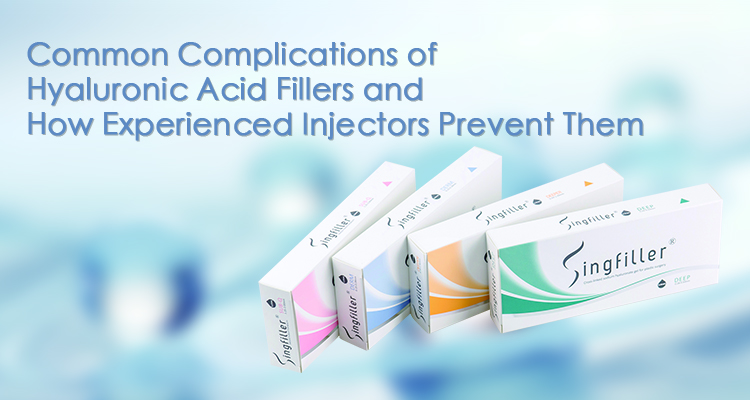
The Singfiller® product portfolio offers targeted solutions for different indications, including:
Singfiller® Fine for fine lines and superficial wrinkles
Singfiller® Derm for cheek augmentation and moderate wrinkle correction
Singfiller® Deep for the frontal bone, temple, zygomatic arch, nose, nasal base, jawline, and chin
Singfiller® Deeper for advanced facial contouring with enhanced structural support
Singfiller® Sub-Q for breast and buttock augmentation
High-quality Products and Manufacturing
Reliable fillers manufactured under strict quality management systems provide consistent gel properties, helping practitioners achieve predictable clinical performance.
Choosing a Reliable HA Filler Manufacturer
For distributors and aesthetic clinics, selecting a trusted manufacturer is just as important as choosing the right filler formulation.
High-quality cross-linked hyaluronic acid fillers should be produced using purified raw materials, advanced cross-linking technology, and rigorous quality control. International certifications such as CE and ISO 13485 also demonstrate a commitment to product safety and manufacturing consistency.
Working with an experienced manufacturer helps clinics and distributors deliver reliable products while building long-term confidence among healthcare professionals and patients.
Conclusion
Hyaluronic acid fillers continue to be one of the safest and most effective options for facial rejuvenation and contour enhancement when used appropriately. While complications such as swelling, bruising, Tyndall effect, filler migration, and vascular occlusion can occur, most risks can be significantly reduced through proper patient selection, accurate injection techniques, and the use of high-quality products.
At Singfiller®, we are committed to providing CE-certified cross-linked hyaluronic acid dermal fillers for a wide range of facial and body indications. Supported by advanced manufacturing technology and strict quality standards, our products help aesthetic professionals and distributors deliver safe, natural-looking, and consistent treatment outcomes.
Looking for a Trusted HA Dermal Filler Supplier?
Explore the complete Singfiller® portfolio to find the right solution for facial rejuvenation, contouring, and body enhancement. Contact our team today to learn more about our OEM/ODM services and global distribution opportunities.